
North American Crop Review
- Tuesday December 11, 2006
This analysis featured in the Dcemebr 11, 2006 issue of the HGCA's MI Prospects, Volume 9, Issue 12
Key points
- US harvested its second smallest wheat crop in almost 30 years
- US wheat exports forecast at 25.2Mt, 8% below last year and less than 25% of world trade
- US maize production is estimated at 272.9M this year, third highest on record
- But the tightest US maize supply situation since 1995/96
- Canadian crops are average in size, but exceptional in quality
This season's US wheat exports will be limited following a reduced a relatively small wheat harvest. Another large maize crop was harvested in the US but demand is such that the supply situation is tight. However, given a record soyabean crop and high ending stocks from last year, US soyabean supplies appear more than adequate. Canadian crops are average in size, but exceptional in quality.
US Wheat - The US harvested its second smallest wheat crop in almost 30 years, following a relatively small sown area and Hard Red Winter (HRW) and spring wheat crops suffering from drought. Total wheat production was 49.3Mt, 14% less than the 2005 harvest and 11% below the five-year average (Table 1).
continue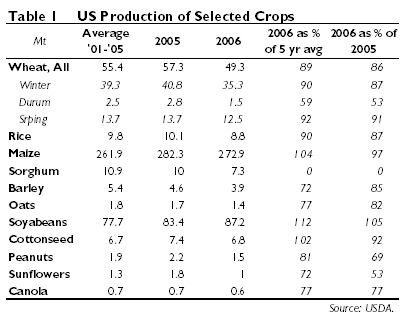 continued
By class, production of Hard Red Winter, Hard Spring Winter, White Winter and durum were, respectively, 27, 8, 15 and 45% lower than in 2005. In contast, Soft Red Winter production was 26% higher following a recovery in sown area. The US Wheat Associates' quality survey indicates that the 2006 quality is slightly above the five-year average for most criteria except for flour yield; a reflection of the hot and dry conditions this summer.
The trend of declining US wheat production and, hence, supplies available for export is a continuing one (Graph 1). No longer is the US able to fill the gap in supplies created by global crop shortfalls. The USDA projects US exports at 25.2Mt, 8% lower than last year and less than 25% of world trade. It projects US ending-stocks at 11.4Mt, 27% below last year and less than 10% of world ending-stocks.
continue continued
US Maize - US maize production this year is estimated at 272.9Mt. While this is 3% smaller than last year's crop and 9% smaller than the record 2004 crop, it is still 4% larger than the five-year average. A 5% reduction in harvested area largely offset better yields almost everywhere. Despite above-average crop and ending-stocks, resulting in the third largest supply ever recorded, the tightest supply situation since 1995/96, when production was severely reduced by drought, has emerged.
The dramatic increase in projected use of maize for fuel ethanol production is anticipated to result in a 5% increase in US domestic use of maize. The USDA projects exports to increase by more than 2% to 55.9Mt, with ending-stocks being reduced by 24.3Mt to 23.8Mt, the lowest level since 1997. Next year it will require a record crop.
US Soyabeans - The USDA estimates the soyabean crop at a record 87.2Mt, almost 5% above 2005. A record area was harvested and yields were very close to last year's record. As a result, soyabean supplies have risen, exceeding domestic use and exports. US soyabean exports continue to have stiff competition from Brazil and Argentina on world markets. Soyabean ending-stocks have quadrupled from the very low levels of just two years ago and are projected to increase to record levels at the end of this season, despite forecast exports of 31.2Mt (up 21% on last year).
Prices and Prospects - US markets did not react in a sustained way to the tightening global supply situation until mid-September. However, higher prices were recorded in March on declining prospects for the US HRW wheat crop and again in June on deteriorating outlook for the Hard Red Spring (HRS) wheat crop. But prices soon faded. The maize market was very sensitive to weather developments all summer but when by September a large crop was virtually assured, maize prices were as low as they had been all year. The rapid decline in the Australian wheat crop, together with very strong demand indications for maize, moved the wheat and maize prices by about a third in a month to mid-October. While wheat prices have since faded somewhat on demand concerns, maize prices continue to advance as the pace of export sales continues to exceed expectations.
Soyabean prices have tended to follow the maize market, trying to maintain a balance of area sown between the two crops. Bean prices are also supported by high international prices for vegetable oils. However, a swing in sown area from soyabeans to maize is expected. This should aid a further rise in US maize output next year.
Also, there are about 15M ha, equivalent to about 10% of the area sown to major crops, in the USDA's Conservation Reserve Program. Indications are that current market prospects are not such as to encourage farming on much of this area. It is known to be not the most productive land and the initial investment necessary to cultivate is substantial.
Canadian Grains - Canadian crops are much better than were earlier supposed. While it was a hot summer on the Prairies, Canadian crops were generally not stressed for moisture. The crop was an early one and, unusually for an early crop, yielded reasonably well. Quality was exceptional with the bulk of the crop being harvested under ideal conditions. Output of the major grains and oilseeds totalled 66.6Mt, 4% less than the high-yielding 2005 harvest but 14% above a 5-year average (Table 2).
continue continued
The dominant class of Canadian wheat is HRS wheat. Given a production of 20.1Mt (up 7%) and almost the entire crop falling into top two grades, supplies of this premium wheat are greater than expected. With the prospect of drought-reduced Hard Red wheat crops in both the US and Canada, the Minneapolis HRS futures market went to almost a US$40 / t premium to the Chicago SRW wheat market in early July. As the size and quality of the Canadian crop became apparent, that premium fell and is currently less than US$5.00 / t. The supply of feed wheat is correspondingly limited, while most of the barley crop is suitable for malting at a time when the EU and Australia, Canada's competition in this market, have very limited supplies.
Canola production is estimated at 9.1Mt, 6% below last year's year record crop. Normally this would exceed domestic and export needs by a wide margin. But Agriculture and AgriFood Canada currently projects domestic use and exports at 8.75Mt with export projections seemingly being raised every month. Canada does not have a significant biodiesel market, but is almost certainly benefiting from that of others. Also, the Australian drought has virtually removed the major competitor for Canadian canola in its primary Pacific market.
David Walker 001 780 434 7615
top of page